
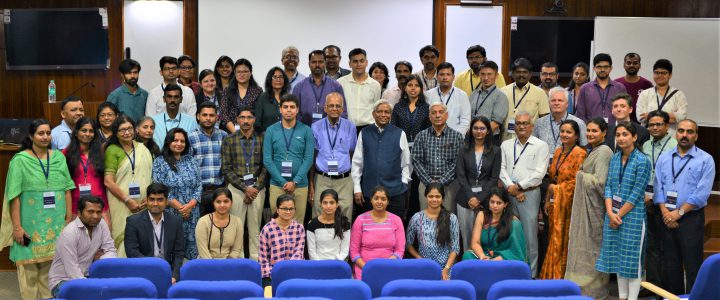
Seminar “The making of India’s first indigenous STM: What lab studies can tell us about S&T policies in India”, 10 Decemer 2019


Indian Institute of Science


on
Open Access seeks to return scholarly publishing to its original purpose: to spread knowledge and allow that knowledge to be built upon. Price barriers should not prevent students, researchers (or anyone) from getting access to research they need. Open Access, and the open availability and searchability of scholarly research that it entails, will have a significant positive impact on everything from education to the practice of medicine to the ability of entrepreneurs to innovate.
International Open Access Week [www.openaccessweek.org] (October 21-27, 2019) is a global, community-driven week of action to open access to research and knowledge in general. The event is celebrated by individuals, institutions and organizations across the world and its organization is led by a global advisory committee. This is an important opportunity to catalyze new conversations, create connections across and between communities that can facilitate this co-design, and advance progress to build more equitable foundations for opening knowledge.


As part of the Water Future Conference in Bengaluru, we organized a special session on “Science Diplomacy and Global Water Challenges” on 26 Sept 2019.
Session Details:
———————————————————-
Title of the Session: Role of Science Diplomacy in Addressing Global Water Challenges
Date: 26 Sept 2019 (Thursday) | 16.30 to 19.30 IST | Hotel Sheraton – Grand Ball Room 2, Bangalore, India
Science Diplomacy, as a practice, is gaining prominence around the world as part of the emerging multi-track diplomacy system. It functions at the intersection of ‘internationalization of science’, ‘science and technology as a foreign policy tool’ and ‘scientific evidence for global policy’. The relevance of non-state, non-diplomatic actors is constantly increasing in international engagement, particularly, towards addressing some of the pressing challenges that the world faces today. Globally, the water crisis has been raising alarm – prolonged droughts, fluctuating agriculture patterns and associated food and energy security challenges, cities running out of the water, issues related safety and accessibility of drinking-water and water-borne health problems, etc. Addressing these challenges require interventions at every possible level – ranging from appropriate policies, having access to necessary know-how, technology transfer and absorption capacity, and, community practices and interventions. In today’s interconnected world, with a tightly-knit value chain around the globe, water-related challenges inevitably require international engagements – global challenges require global solutions! This special session aims to discuss the role and importance of various stakeholders (diplomatic and non-diplomatic) in a comprehensive Science Diplomacy Framework in addressing global water challenges.
About the session:
The session
Lead speakers include,
Amy Luers, Executive Director, Future Earth
András Szöllősi-Nagy, Chair, Water Future & Professor, Institute for Sustainable Development Studies
Anik Bhaduri, Director, Water Future & Professor, Australian Rivers Institute
C H Chandrasekhar, Senior Head – South & East, Wastewater BU, Larsen & Toubro
Gert Heijkoop, The Consul General of Netherlands in Bangalore
Jean-Christophe Mauduit, Lecturer in Science Diplomacy, University College London
Moderator: B. Chagun Basha, DST- Science, Technology, and Innovation Policy Fellow, DST-CPR-IISc
This special session is organized by the DST-Centre for Policy Research at IISc Bangalore in association with the Consulate General of the Kingdom of the Netherlands in Bangalore and Sustainable Water Future Programme.

organized by
The DST-Centre for Policy Research, Indian Institute of Science (IISc), Bengaluru
in association with
The United Nations University – Maastricht Economic and Social Research and Training Centre on Innovation and Technology (UNU-MERIT), Maastricht, The Netherlands
The DST- Centre for Policy Research (DST-CPR) at Indian Institute of Science, in association with the United Nations University -Maastricht Economic and Social Research and Training Centre on Innovation and Technology (UNU-MERIT) is conducting a 5-day capacity-building program on Design and Evaluation of Innovation Policies (DEIP) (with a specific focus Scientometrics). DEIP provided by UNU-MERIT is proven to be popular since its inception in 2004, for policy makers in science, technology and innovation (STI) policy, particularly in developing countries. In this edition – DEIP 2019 Bangalore – DST-CPR is joining hands to bring-in complementary expertise, with a specific focus on STI data with relevance to the local policy needs.
The workshop aims to cover the topics in the form of lectures, panel discussions, hands-on trainings and group presentations. The topics include,
Measurement: Standards and Manuals (Frascati and Oslo) – data-collection methodologies – applying the manual standards in OECD vs Non-OECD countries – R&D statistics and innovation surveys questionnaires – bibliometric databases – Web of Science, Scopus, Google Scholar, local repositories – tools and techniques- data mining and curation- existing techniques and alternate models – issues related to data standardization -ensuring accuracy, accessibility, availability and international comparability.
Indicators: S&T indicators – innovation indicators – S&T vs innovation indicators composite/cross-cutting indicators – scoreboards and indexes – bibliometric indicators (macro, meso and micro levels) – “the bibliometric toolbox” – quantitative and qualitative evaluation – opportunities and limitations – research evaluation – what can and cannot be captured (measured and evaluated) through the available indicators? – challenges and need for new form of Indicators.
Policy Relevance: Applications (uses and abuses) of indicators in various stages of policy process (evidence for policy framework) – uses and abuses of bibliometric indicators – applications of bibliometric analysis – HEI/ University ranking frameworks – sectorial research performance evaluation – funding policies – in S&T and Innovation policies. – S&T policy vs innovation policy – policy indicators – Innovation (eco)system approach – forecasting and impact assessment.
The sessions will be conducted by distinguished professors and experts from organizations including, the United Nations University- Maastricht Economic and social Research and training center on Innovation and Technology (UNU-MERIT), Maastricht, The Netherlands, the Organization for Economic Co-operation and Development (OECD), Paris, France and the DST-Centres for Policy Research (DST-CPRs).
The Programme targets entry/mid-level scientists and officials in relevant government agencies who use STI data for various policy, program and scheme planning and implementation. Also, we encourage policy researchers/scholars who use/work on STI Indicators/ Scientometric Analysis to apply.
How to Apply
Online application link: https://goo.gl/aWXGZr
Important Dates
The last date for application: 24th Feb 2019
Programme dates: 25-29 March 2019
Registration
The selected participants will be asked to register for the workshop through a Demand Draft of Rs 1000 in favor of The Registrar, IISc.
Financial Support
The travel and accommodation of selected participants might be partially/fully supported based on the availability of funds.
Programme Coordination
Professor Antony Arundel
UNU-MERIT, Maastricht, The Netherlands
Dr. B. Chagun Basha
DST-CPR, IISc, Bangalore, India


DST Centre for Policy Research
Centre for Society and Policy
Indian Institute of Science
invites you to the seminar in the Policy Lecture Series entitled
A Public Library of India
by
Carl Malamud
President and Founder, Public.Resource.Org
at 4:00 p.m. on Friday, 28 December 2018, in the Seminar Hall of the Centre for Society and Policy (next to the Health Centre), IISc.
Abstract: Carl Malamud, founder of Public Resource, will speak about his efforts to make more information from India and about India online. He’ll discuss the Hind Swaraj and Public Library of India collections he maintains on the Internet Archive, efforts underway to increase high-quality digitization efforts throughout India, and his vision for a true Public Library of India effort, an effort that would take a decade and a national commitment to accomplish.
Speaker Biosketch: Carl Malamud is the Founder and President of Public.Resource.Org, a nongovernmental organization based in the United States. He was previously founder of the Internet Multicasting Service, a nonprofit that started the first radio station on the Internet and was responsible for making the SEC EDGAR database available. He is the recipient of the Berkman Award from Harvard, the Pioneer Award from the EFF, and the Bill Farr Award from the First Amendment Coalition.
Author of 9 books (including “Code Swaraj” co-authored with Sam Pitroda), Malamud works actively in India as well, and is engaged in a Public Internet Litigation suit to make Indian Standards available to the public at no charge.
All are Welcome.


DST Centre for Policy Research
Centre for Society and Policy
Indian Institute of Science
invites you to the seminar in the Policy Lecture Series entitled
Chinese Rural S&T Development Policies and Practices: Introduction and Outlook
by
Dr. Zhuqing Xu
[Chinese Academy of Science and Technology for Development (CASTED), Beijing]
at 4:00 p.m. on Thursday, 27 December 2018 in the Seminar Hall of the Centre for Society and Policy (next to the Health Centre), IISc.
Abstract:
Dr. Xu will introduce different stages of Chinese rural S&T development policies in the last 40 years. Focusing on the top-down policy system and the bottom-up
local practices, she will explain why the rural S&T development become incredibly important after the central government launched the Rural Revitalization and
what should the Chinese government do to foster a flourishing Innovation and Entrepreneurship environment in Rural China.
Speaker biosketch: Dr. Zhuqing Xu is an Associate Researcher of Chinese Academy of Science and Technology for Development (CASTED), affiliated to Ministry of
Science and Technology of CHINA. She got her PhD Degree from Renmin University of China in 2012. Her research areas are Science, Technology and Innovation
Policy, Rural Development based on ICTs, Poverty Alleviation, Rural Entrepreneurship by S&T.
All are Welcome.


Venue: Centre for Society and Policy, Indian Institute of Science Bangalore
Date : 28 Nov 2018 (Wednesday) | Time : 4 pm


Venue: SERC Auditorium, Indian Institute of Science Bangalore
Date : 26 Oct 2018 (Friday) | Time : 5.30 pm
Dear All, The DST- Centre for Policy Research at the Indian Institute of Science and J.R.D. Tata Memorial Library, IISc., are pleased to invite you to a
Discussion Forum on “Global Equity, Libraries and Open Access”
Speakers:
Subbiah Arunachalam (DST-Centre for Policy Research, IISc),
T.A. Abinandanan (Indian Institute of Science),
Madhan Muthu (Azim Premji University),
Hamsa Kalayani (National Institute of Advanced Studies),
Francis Jayakanth (JRD Tata Memorial Library, IISc), and
Leena Shah (Directory of Open Access Journals)
Please confirm your participation via RSVP: https://goo.gl/TzbTuN
There will be High Tea at 5.00 pm. Please join us!
This event is a part of International Open Access week activities planned at IISc Bangalore, organized by DST-Centre for Policy Research at IISc in association with National Institute of Advanced Studies (NIAS), Karnataka State Library Association (KALA), JRD Tata Memorial Library, Science Policy Group (SPG) and International Scientific and Technological Education Program (i-STEP).
International Open Access Week (October 22-28, 2018) is a global, community-driven week of action to open up access to research. The event is celebrated by individuals, institutions, and organizations across the world, and its organization is led by a global advisory committee. This is an important opportunity to catalyze new conversations, create connections across and between communities that can facilitate this co-design, and advance progress to build more equitable foundations for opening knowledge.
The official hashtag of Open Access Week is #OAweek.


Venue: Faculty Hall, Indian Institute of Science Bangalore
Date : 23 Oct 2018 (Tuesday) | Time : 4pm
Open Access (OA) seeks to return scholarly publishing to its original purpose: to spread knowledge and allow that knowledge to be built upon. Price barriers should not prevent students, researchers (or anyone) from getting access to research they need. Open Access, and the open availability and searchability of scholarly research that it entails, will have a significant positive impact on everything from education to the practice of medicine to the ability of entrepreneurs to innovate.
Panelists:
1. Arul George Scaria – National Law University, Delhi
There will be High Tea at 5.30 pm. Please join us!
Please confirm your participation via RSVP: https://goo.gl/rLqhnw
This event is a part of International Open Access week activities planned at IISc Bangalore, organized by DST-Centre for Policy Research at IISc in association with National Institute of Advanced Studies (NIAS), Karnataka State Library Association (KALA), JRD Tata Memorial Library, Science Policy Group (SPG) and International Scientific and Technological Education Program (i-STEP).
International Open Access Week (October 22-28, 2018) is a global, community-driven week of action to open up access to research. The event is celebrated by individuals, institutions and organizations across the world, and its organization is led by a global advisory committee. This is an important opportunity to catalyze new conversations, create connections across and between communities that can facilitate this co-design, and advance progress to build more equitable foundations for opening knowledge. The official hashtag of Open Access Week is #OAweek.